A tapestry of stories, woven through time
Hi Mart, thanks for your time today, I love your studio. Can you introduce yourself and your journey into tapestry?
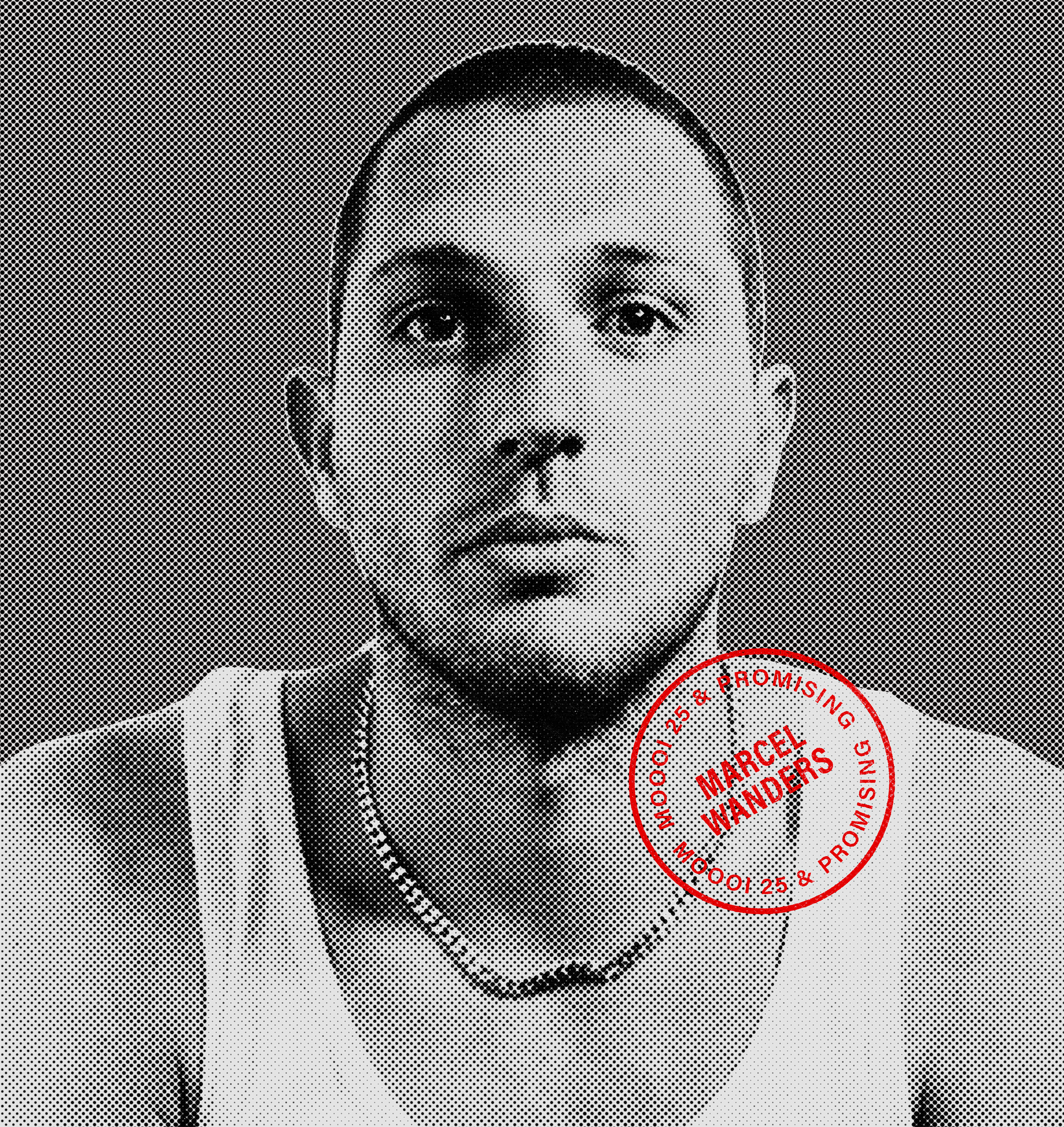
My name is Mart Veldhuis. I’m an Illustrator, Artist and Textile Designer from Amsterdam.
I graduated as an illustrator at art school in Utrecht, and towards the end of my studies I became more interested in textiles and tapestries. That’s the path I’m following now – designing large-scale tapestries with a lot of detail.
My graduation project was about the social loan system in the Netherlands. It was about student debt and what it does to people. It came from my own experience and what I saw around me, with students no longer receiving scholarships and having to take on more and more debt.
A tapestry felt like a powerful way to tell that story. It allowed me to create something large, something people could stand in front of and really take time with. I even tried to sell the piece for the amount of my own student debt. And it worked. That moment made me realise I could tell bigger stories through tapestry.
What drives you as an artist?
I try to find stories that hit me, and that hit a generation, and translate those as an illustrator. At its core, illustration is about translating the world around you. You translate stories, but always through your own eyes. For me, an illustrator is a storyteller.
I like working with contrast as well. On one side, illustration can be very direct: small, symbolic, next to text. But tapestry is the opposite. It’s large, detailed, layered. You can really lose yourself in it. That combination—between small and large, simple and complex—is something I really enjoy exploring.
What draws you to tapestry as a medium?
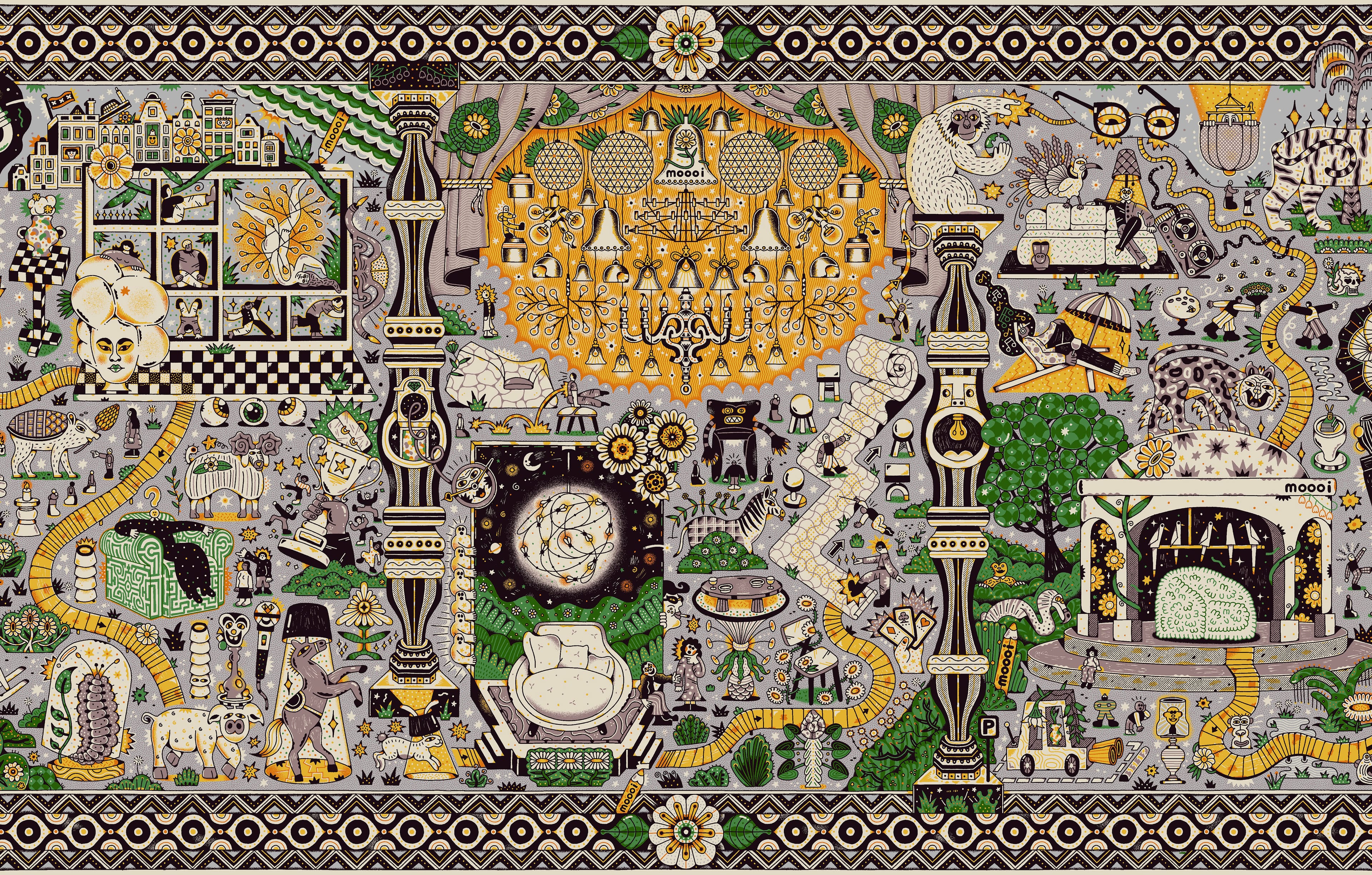
What I love about tapestry is the richness and the layers. I can have a story in my head when I design it, but because of the level of detail, people can also create their own stories when they look at it. They connect the dots in their own way.
That’s something I really like, seeing how people interpret the work differently. You can experience a tapestry from far away, as one image, but also up close—where you start to see textures, yarns, and smaller stories woven into it. There are many layers to discover.
How did you approach translating 25 years of Moooi into one piece?
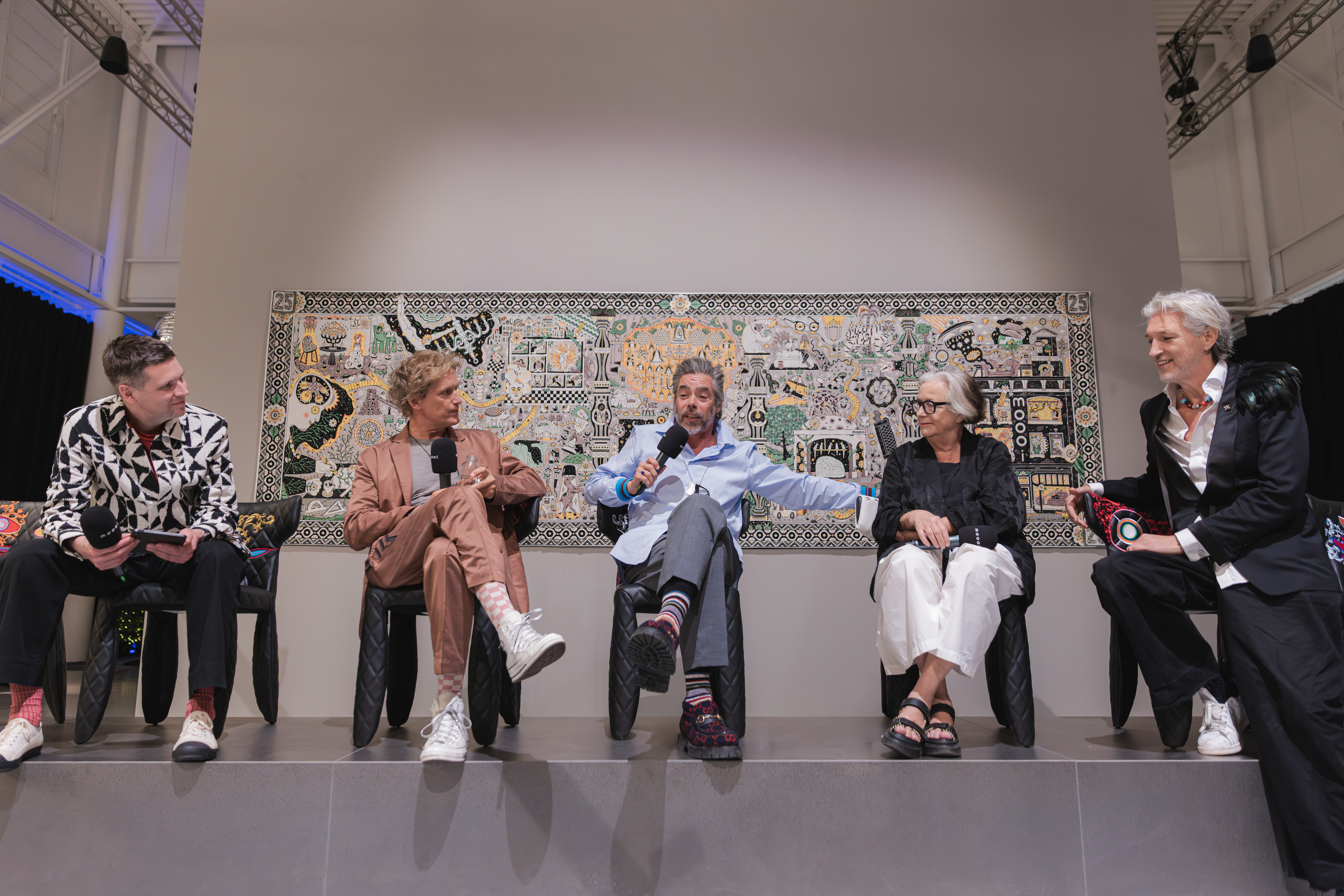
Twenty-five years is a long time, so you can’t translate it into just one image. For me, it was about giving attention to all the parts that hold meaning in Moooi’s history. Every moment, every designer, every collaboration deserves its own place. That’s why the tapestry is so detailed, because you can’t reduce 25 years into something small.
It was really interesting to dive into Moooi’s brand book and history. I started to understand how much Moooi has contributed, not just to design, but to designers themselves, especially young and upcoming creatives.
All the furniture, the photography... they already carry symbolic value. So, I translate those elements into my own style.
Can you walk us through your process?
I start by drawing. Just drawing a lot. I take references of furniture, objects, photography and reinterpret them in my own way. I try to bring them to life, almost making them feel animated. At first, I create many small illustrations. Then, when I feel I have enough, I start combining them. It’s almost like a puzzle. One big, fun puzzle.
I always knew this piece would be a timeline, so it needed a beginning, a middle and an end. From there, I work towards a full composition. That first full sketch is one of the most important steps, it’s where the story comes together. After that, it moves into material decisions: what yarns, what bindings, what textures will bring it to life. But even until the very last moment, I’m still adjusting details.
Your work feels very fluid. It’s almost like everything is connected. Is that intentional?
Yes, definitely.
In my style, I like everything to sit next to each other. Nothing overlaps, but everything flows. It’s almost like a dance. Even though it might look busy, everything is carefully thought through. Every shape connects to another shape. That flow is actually one of the most difficult parts... to make everything feel natural and balanced while still being very detailed.
What do you hope people experience when they see the tapestry?
I hope people take their time with it. Because it’s so large, people start somewhere. Perhaps at a detail that catches their attention and then follow the story, connecting different elements. It’s fun to see how people figure things out in their own way, even if it’s not exactly what I intended. There’s the bigger story, but also many smaller ones within it. And depending on how you look at it, far away or up close, you experience something different.
What does this tapestry represent to you?
Of course, it represents 25 years of Moooi, but it’s also more than that.
For me, it’s an ode to the maker. An ode to designers, photographers, creatives. People who put time, effort and passion into their work. People who work late, who care about detail, who want to make something meaningful.
It’s not just about Moooi. It’s about everyone trying to create something of their own.
Looking at your own journey, what does this moment mean to you?
For me, this is a big step.
I graduated only a few years ago, so this is my first time showing work internationally on this scale in Milan, and beyond. It makes me realise that there’s more possible and that the ceiling can go higher. It motivates me to keep pushing, to keep growing, and to put even more into what I do.
Thank you so much for your time, Mart. Really appreciate it.
Yeah, no problem at all. I hope it was good. Because I enjoyed this chat. Thank you.